
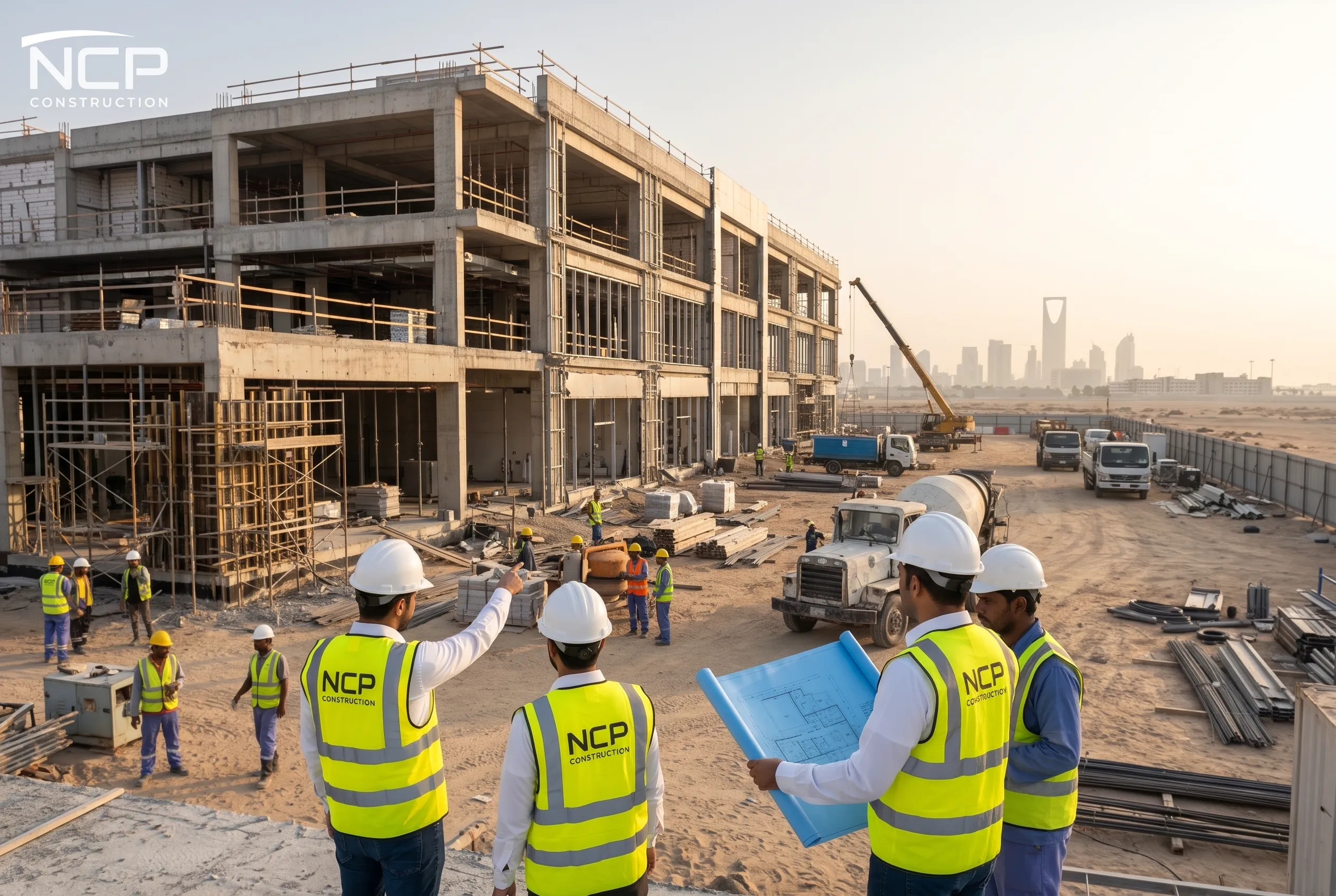
You have a plot in Jeddah and a clear idea: a residential building for rental income, a showroom on a main road, or a new head office. The first real question is who will run the project from the first drawing to the last key. That is the job of the turnkey construction companies Jeddah owners rely on: one contractor takes on design, permits, construction, finishing and handover, and you receive a ready building. This guide explains how the model works, what it saves you, and how NCP delivers turnkey projects step by step.
Communications
Phone & E-Mail
Drop A Line
What Is the Turnkey / EPC Model?
Turnkey means you sign with one party that is responsible for the whole project, and you get back a finished building you can open and operate. You set the requirements and the budget, and the contractor handles the rest. You can see everything that falls under that scope on the NCP services page.
In larger contracts the same idea is called EPC: Engineering, Procurement and Construction. The practical difference is simple. In the traditional route, the owner hires a design office, then a structural contractor, then a finishing contractor, then a joiner, then separate MEP trades. In the turnkey route, all of those links become one contract, one schedule and one point of responsibility. That is why international investors who search for an EPC contractor Jeddah usually mean the same thing, and our guide to construction companies in Saudi Arabia explains how to vet these firms before you sign.
Why does Jeddah need special attention? The city sits on coastal ground, many districts have a shallow water table, and humidity is high enough to affect materials and finishes. That makes design and site coordination critical, a point we covered in detail in our article on choosing a construction company in Jeddah.
The model is not for every owner. If you have an in-house team that manages trades daily, you may split the packages yourself. If you want a finished asset by a fixed date without chasing details, an integrated contract fits better, and we say so honestly before proposing the right scope of work.
4 Advantages of a Single Turnkey Contractor
The short answer: one accountable party, a shorter timeline, a clearer budget, and fewer disputes between trades. These gains show up clearly when you compare projects delivered under one contract with projects split across many contractors.
1. One Party Answers for Everything
When the HVAC is late because the ceiling is not ready, and the ceiling is late because the electrical rough-in is unfinished, every trade blames the next one. With a turnkey contractor Jeddah owners deal with, that argument does not exist. One party owns the sequence, starting with the civil and structural works and everything that follows.
2. A Shorter Schedule
Because design and execution sit under one roof, long-lead items such as lifts and central AC units can be ordered while permits are still in progress, instead of waiting for approval first. You can ask our team for an indicative schedule for your project through the NCP contact page.
3. A Budget You Know From Day One
In an integrated contract the full scope is priced before work starts, so you know the total and exactly what it covers. That matters to any investor calculating rental or resale returns, which is why we price from approved drawings and written specifications for finishing works, not from general estimates.
4. Consistent Quality From Structure to Interior
A building designed and built by one team comes out consistent: door sizes match the openings, lighting fits the ceilings, and joinery is made to the real site dimensions. You can see that precision in the architectural woodwork we produce inside the same project instead of contracting it separately.
Project Phases: From Drawings to Handover
Projects run by turnkey construction companies Jeddah rely on three main phases, preceded by a briefing session to define your needs. The permit steps follow the official Balady building permit service, but an integrated contractor coordinates every party on your behalf.
Phase 1: Balady Permits, Approvals and Civil Defense
The phase starts with understanding what you want: number of floors, type of use, target tenants or customers, and budget. Architectural and structural drawings are then prepared and checked against the Saudi Building Code, the reference applied by the Ministry of Municipalities and Housing and the General Directorate of Civil Defense.
Under the current Balady process, the owner authorizes a licensed design office; the application goes through the insurance company to a technical inspection firm that checks the design against the code, the municipality approves it, and then the supervising office and the building contractor are assigned. For applications submitted after 25 June 2025, the latent defects insurance policy is issued within the same Balady journey. The NCP engineering team follows each of these steps so your time is not lost between offices.
Civil Defense requirements cover fire alarms, firefighting systems, emergency exits, and the fire performance of materials, and they are stricter for commercial buildings and showrooms. We build them into the design from day one instead of fixing them later, the same approach we use across all NCP construction services.
Phase 2: Structural Works and Civil Envelope
Site work begins here: soil investigation, excavation, dewatering where needed, footings, then the concrete frame of columns, beams, and slabs, followed by blockwork and waterproofing. In Jeddah, we pay particular attention to foundation tanking and salt-resistant concrete, as detailed on our civil work service page.
The supervising engineer witnesses concrete tests and records each pour. We send the owner regular photo reports with progress percentages. You can see this commitment in the NCP project portfolio.
Phase 3: Interior Fit-Out and MEP Commissioning
Once the frame is complete, the visible work starts: plastering, paint, flooring, false ceilings and facades, alongside electrical, plumbing, HVAC, and fire systems (MEP). Coordination is delicate here, since a wrong sequence means breaking finished surfaces, which is why we run interior and exterior finishing on one schedule with the MEP trades.
Joinery follows: doors, wardrobes, counters, and wall cladding, then test runs of every system and correction of any remarks. The final steps are the occupancy certificate and handover. A good example of an integrated commercial job we delivered is the Trane Dallah Trading project.
Before handover, we walk the site with the owner and build a snag list that records every remark, however small: a door that needs adjusting, a paint mark, a switch in the wrong place. The project is not considered handed over until the list is closed. You then receive as-built drawings, equipment manuals, and warranty certificates, the same standard we apply to our villa finishing work in Jeddah.
How Are Commercial Turnkey Projects Different?
Commercial jobs differ from residential ones in two ways: stricter safety rules and a much higher cost of delay. Commercial turnkey projects in Jeddah include showrooms, restaurants, offices, and mixed-use buildings, and all of them need a contractor who understands commercial operations before work starts.
Take a leased showroom. Every month of delay before opening is rent paid with no sales. So the schedule becomes part of the contract, imported materials are ordered early, and some packages run in parallel. NCP has delivered restaurants, cafés, and offices in the Kingdom, and you can browse them on the projects page.
How NCP Controls the Budget and Prevents Hidden Costs
Two things: a written scope and documented changes. Most hidden costs in construction do not come from bad faith. They come from a scope that was vague at the start, and that is what we fix when preparing any turnkey project proposal.
Many owners ask first about the cost of building a turnkey apartment building. The honest answer is that it depends on plot size, number of floors, foundation type, finishing level (economy, mid-range, or luxury), and steel and concrete prices at the time of construction. Any figure given before seeing the land and drawings is a rough guess. A real price comes after studying the project, and you can request one by contacting the NCP team.
To keep the budget under control, we rely on a few practices:
- A detailed bill of quantities for every item, from rebar to door handles, tied to drawings approved under the Saudi Building Code.
- Approved material samples before procurement, so the owner never receives something below expectations, especially in joinery and woodwork.
- Written change orders: any change the owner requests is priced and approved in writing before it is built, so there is no surprise invoice at the end, a principle we stress in our guide to choosing a contractor in Saudi Arabia.
- Payments linked to progress: you pay only for a completed and documented stage, as we do across NCP delivered projects.
These practices do not remove every risk. But they make each surprise visible and measured instead of turning it into a dispute. NCP was founded in 2012 and has worked this way on residential, commercial, and industrial projects in several Saudi cities, as our About NCP page explains.
How to Choose the Right Turnkey Contractor
Choose the company that can show you finished projects, give you a contract with a clear scope, and execute with its own in-house teams rather than acting as a middleman who passes packages to subcontractors. That last point is what separates a company that builds with its own crews from one that only manages.
Before you sign, ask any contractor these questions:
- Can I visit similar finished projects? A site visit shows real quality, which is why we publish our completed work by client name.
- Which works do you execute yourselves? A firm with its own civil, finishing, and joinery teams controls quality and time better, as with the four NCP service lines.
- How do you handle change orders? The answer should be written in the contract, not a verbal promise, as covered in our Jeddah contractor guide.
- Who will be my project manager? Ask who you will deal with daily. You can put this question straight to the NCP team.
- What guarantees apply after handover? Ask about the maintenance period, the waterproofing warranty, and the latent defects insurance linked to the permit on Balady.
Start Your Project With NCP
The first step is easy: send us the plot or building location, the project type, and a rough budget. We will set up a meeting to understand your needs, then share an initial concept and scope. All it takes is to book a consultation with NCP.
If you already have drawings, we review them and suggest changes that could lower cost or improve operation. If you do not, we start with you from the idea. Either way, you will see early on how the turnkey construction companies Jeddah investors trust should work from the inside and why our integrated services make life easier for owners.
Communications
Phone & E-Mail
Drop A Line
Frequently Asked Questions
What is the difference between turnkey and traditional contracting?
In traditional contracting, you hire several parties and coordinate them yourself. In turnkey, you hire one party responsible for design, construction, and handover, as with the NCP turnkey service.
Does the contractor obtain the building permit?
The contractor coordinates with the design office and authorities until the permit is issued, while the owner remains the applicant on Balady and authorizes the design office.
How long do turnkey construction companies Jeddah developers hire take to deliver?
It depends on size. A showroom or office fit-out may take weeks, while a full residential building takes months. We give you a detailed schedule after studying the project via the contact page.