
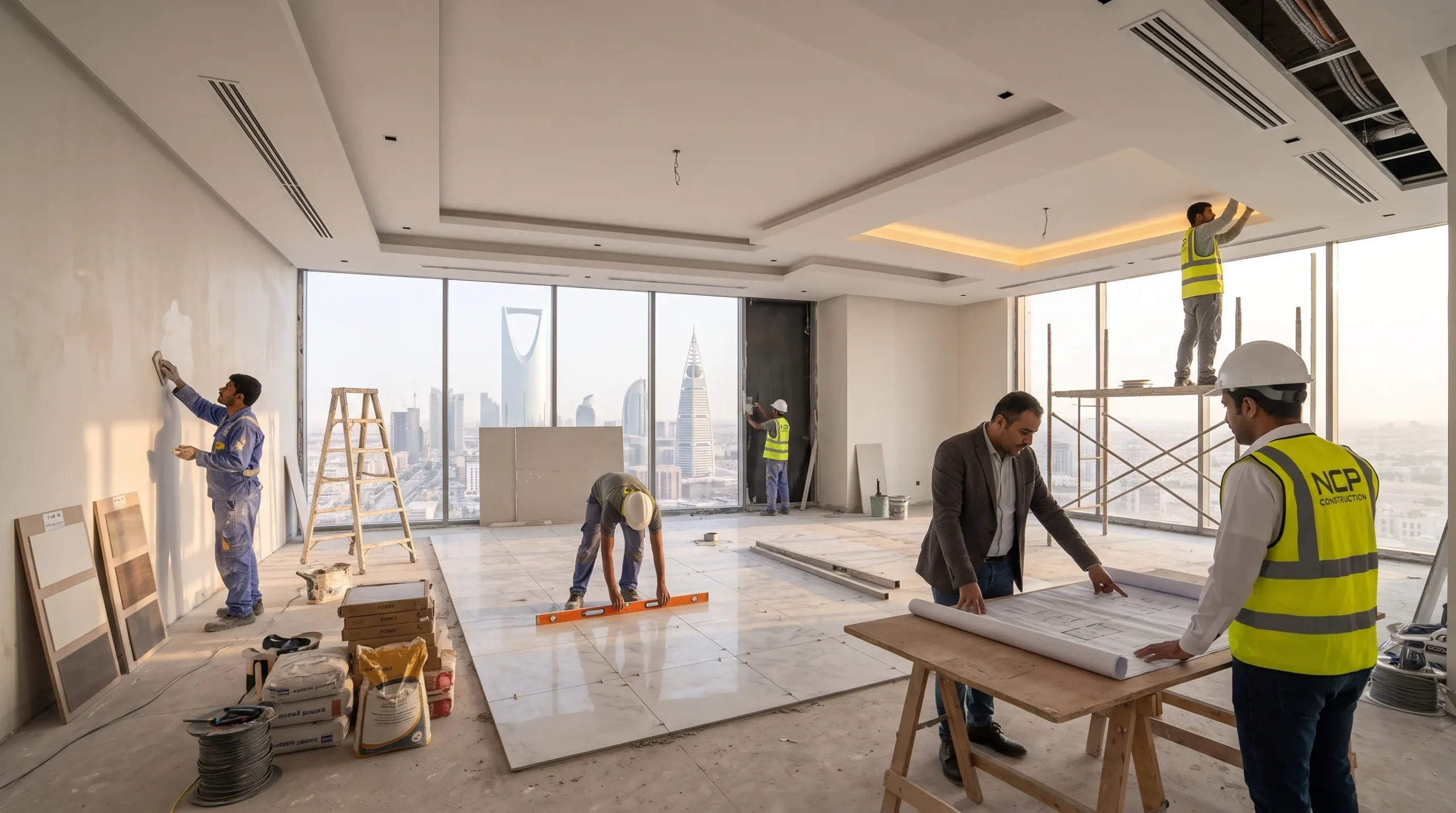
Choosing an interior finishing company Riyadh decides how your space looks on handover day and how it holds up ten years later. Plaster that cracks after one summer, tiles that sound hollow when you walk on them, a ceiling that hides a leaking AC duct: these problems almost always come from execution, not from the design. This guide explains what interior finishing covers, which materials suit Riyadh’s climate, how the work runs step by step, and what drives the price, so you can judge any contractor fairly, including NCP’s finishing works team.
It is written for villa owners, apartment buyers, and companies fitting out offices, showrooms, cafés, or restaurants. If your project starts from an empty plot rather than a ready shell, it is also worth reading how turnkey projects bring design, structure, and finishing under a single contract and a single point of responsibility.
Communications
Phone & E-Mail
Drop A Line
What Is Interior Finishing?
Interior finishing is all the work that turns a concrete shell into a usable room: plaster, putty, paint, flooring, gypsum ceilings, wall cladding, doors, and the final fixtures. It is the last major stage of construction and the one you see and touch every day. NCP describes its role as moving a project from the structural or shell stage into a ready-to-use, operational space, a definition you can see applied across its completed villa and office projects.
Finishing also sits on top of everything you will never see again. Electrical conduits, AC ducts, drainage, and fire lines must be installed and tested before a single ceiling board goes up. For homes, the Saudi Council of Engineers publishes guidelines for the Saudi Residential Building Code (SBC 1101 and 1102), and a serious contractor works to those requirements instead of around them.
A typical interior finishing package includes:
- Plastering and putty on walls and ceilings
- Paint systems, from primer to decorative coats
- Floors in porcelain, ceramic, marble, natural stone, or vinyl
- Gypsum board ceilings with coves, light slots, and access panels
- Feature walls, cladding, and joinery such as doors and wardrobes
Joinery deserves its own mention, because doors, wardrobes, and kitchen cabinets often come from a different workshop than the rest of the site. When two separate teams measure the same door opening, their numbers rarely match. Keeping carpentry with the same contractor, as NCP does through its wood work services, removes that gap and the rework that comes with it.
Materials Used in Riyadh Projects
The right materials for Riyadh are the ones that handle heat, dust, and daily wear without constant upkeep. Summer temperatures often reach 45°C, fine sand finds its way into every joint, and air conditioning runs for most of the year, so material choice is a practical decision before it is an aesthetic one. A good contractor will show you physical samples and finished mock-ups, a standard step among the leading construction companies in Saudi Arabia.
Floors
Porcelain is the default for most apartments and offices because it resists scratches and stains and copes with heavy foot traffic. Marble and natural stone appear in villa entrances and majlis rooms, where their depth and weight justify the higher price and the periodic polishing. Vinyl and specialized flooring systems suit clinics, gyms, and back-of-house corridors. Transitions between two flooring types are where weak workmanship shows first, so look closely at how they were handled in a contractor’s past residential and commercial work.
Walls and Paint
Gypsum plaster gives smooth interior walls, followed by two coats of putty and a paint system of one primer plus at least two finish coats. Washable, low-odor emulsions work well in bedrooms and offices, while kitchens and bathrooms need moisture-resistant products or tiles to full height. Textured coatings and feature walls add character to lobbies and living rooms, and they are often where interior decoration and finishing meet, so the finisher should read the designer’s drawings closely and coordinate before ordering materials, as NCP’s fit-out process guide explains.
Ceilings
Suspended gypsum board ceilings hide ducts, sprinkler pipes, and cabling while leaving room for cove lighting and recessed spots. Moisture-resistant board belongs in bathrooms and kitchens. Because ceilings carry light fittings and AC grilles, the efficiency of what goes into them matters as well: SASO licenses energy efficiency labels for air conditioners and other regulated products, and checking those labels before you approve a fixture list keeps electricity bills down for years.
Wet Areas
Bathrooms and kitchens are where finishing mistakes cost the most, because water damage spreads behind tiles long before anyone notices it. The floor needs a waterproofing membrane that turns up the walls, a correct slope toward the drain, and a flood test before tiling. Cement-based adhesives and epoxy grout in showers last far longer than the cheaper options. Waterproofing often starts in the civil package, so it helps to know how a civil works contractor in Riyadh prepares slabs before finishers arrive. Also ask for photos taken before the tiles went down, since that is the only moment the waterproofing is visible.
How the Work Runs, Step by Step
A well-run finishing package follows a fixed order: survey, samples, zoned execution, then inspection and handover. Skipping or reshuffling those steps is the main cause of delays and damaged finishes, and it is the first thing to ask about when you interview any interior finishing company Riyadh. The sequence below follows the one NCP sets out on its finishing works service page.
1. Drawings and Site Survey
The team studies the architectural and interior drawings, the bill of quantities (BOQ), and the real condition of the site: bare concrete, shell and core, or a space that is already partly finished. Floor levels and wall verticality get measured at this point, because fixing a 2 cm slope after tiling means breaking tiles. If the building is still at structure stage, NCP’s civil work services cover that phase before finishing begins.
2. Materials and Mock-ups
Before full execution, the contractor finishes a sample area so you can see colors, tile patterns, and joint widths in real light rather than in a brochure. Approving a mock-up of one bathroom or one wall takes a few days and prevents arguments over an entire floor later. NCP explains how this fits into the bigger picture in its guide to the fit-out project process.
3. Zoned Execution
The site is divided into zones, and each zone moves through ceilings, walls, floors, and final fixtures in that order. Electrical, HVAC, and fire teams coordinate with the finishers so nobody drills through a freshly painted wall or lifts a newly laid tile. It sounds obvious, but this coordination is exactly where an experienced finishing contractor in Riyadh earns its fee, and it is why NCP keeps several trades within one company.
4. Inspection and Handover
NCP runs an internal inspection before inviting the owner or consultant for snagging. Remarks go on a written list, each one is closed and signed off, and the site is cleaned so furniture can move in straight away. Whoever you hire, ask for this list in writing; it becomes your record if a problem appears later, and you can request a site visit to see how the process works on a live project.
What Determines the Cost?
Finishing cost in Riyadh depends mainly on area, material grade, site condition, design complexity, and timeline. Two apartments of the same size can end up far apart in price because one uses imported marble and the other local porcelain. Rather than relying on a price per square meter given over the phone, send your drawings and ask for an itemized quote through NCP’s contact page.
The main cost drivers are:
- Area and layout: more rooms and wet areas mean more corners, joints, and labor hours.
- Material grade: imported stone, designer paint systems, and custom joinery raise the total quickly.
- Site condition: a clean shell costs less to finish than a space that needs demolition and correction.
- Design complexity: curved ceilings, coves, and feature walls need more skilled hours.
- Schedule: a compressed timeline needs larger crews and sometimes night shifts.
For apartment finishing in Riyadh, the biggest swing usually comes from bathrooms and kitchens, since they combine tiling, waterproofing, plumbing fixtures, and joinery in small rooms. Villas add exterior work such as marble and stone cladding, GRC, and landscaping, which NCP lists as a separate scope on its finishing services page.
One practical tip: ask every interior finishing company in Riyadh that bids on your project to price the same BOQ. Otherwise you end up comparing a quote that includes waterproofing and access panels with one that quietly leaves them out. If you would rather have design, structure, and finishing priced as one package, compare those quotes against a turnkey contract.
NCP's Quality Guarantee
NCP’s quality approach rests on checks at every stage rather than one inspection at the end. Samples and mock-ups are approved before large-scale work starts, finishing engineers and technicians supervise continuously, and levels, alignment, joints, and color consistency are reviewed on a regular schedule. You can read more about the company behind this approach on the About NCP page.
The second part is coordination. Because NCP handles civil work, woodwork, and finishing within one system, the team that builds a wall is the same one that plasters it, paints it, and fits the door in it. That is a big reason clients choose an interior finishing company Riyadh that covers several trades instead of hiring separate crews, and the results show in the office, retail, and restaurant projects in NCP’s portfolio.
Finally, handover is documented. The closed snag list, the approved samples, and the material data sheets give you a clear reference for future maintenance. Ask about the warranty terms for each material when you talk to the NCP team, since tiles, paints, and joinery each carry different manufacturer warranties.
Communications
Phone & E-Mail
Drop A Line
Frequently Asked Questions
How long does interior finishing take in Riyadh?
It depends on area, scope, and site condition. An apartment is usually measured in weeks and a villa with exterior works in months. NCP fixes a timeline after the site survey and mock-up approval, as described in its fit-out process guide.
Can NCP handle finishing only if the structure is already built?
Yes. NCP can execute finishing as a standalone package starting from shell and core or grey structure, covering plaster, paint, floors, ceilings, and feature walls through its finishing works service.
How do I pick the best interior finishing company in Riyadh?
Visit at least one completed project in person, ask for an itemized quote based on your BOQ, confirm that mock-ups are approved before full execution, and ask how the contractor coordinates with MEP trades. You can start by booking a consultation with NCP.