
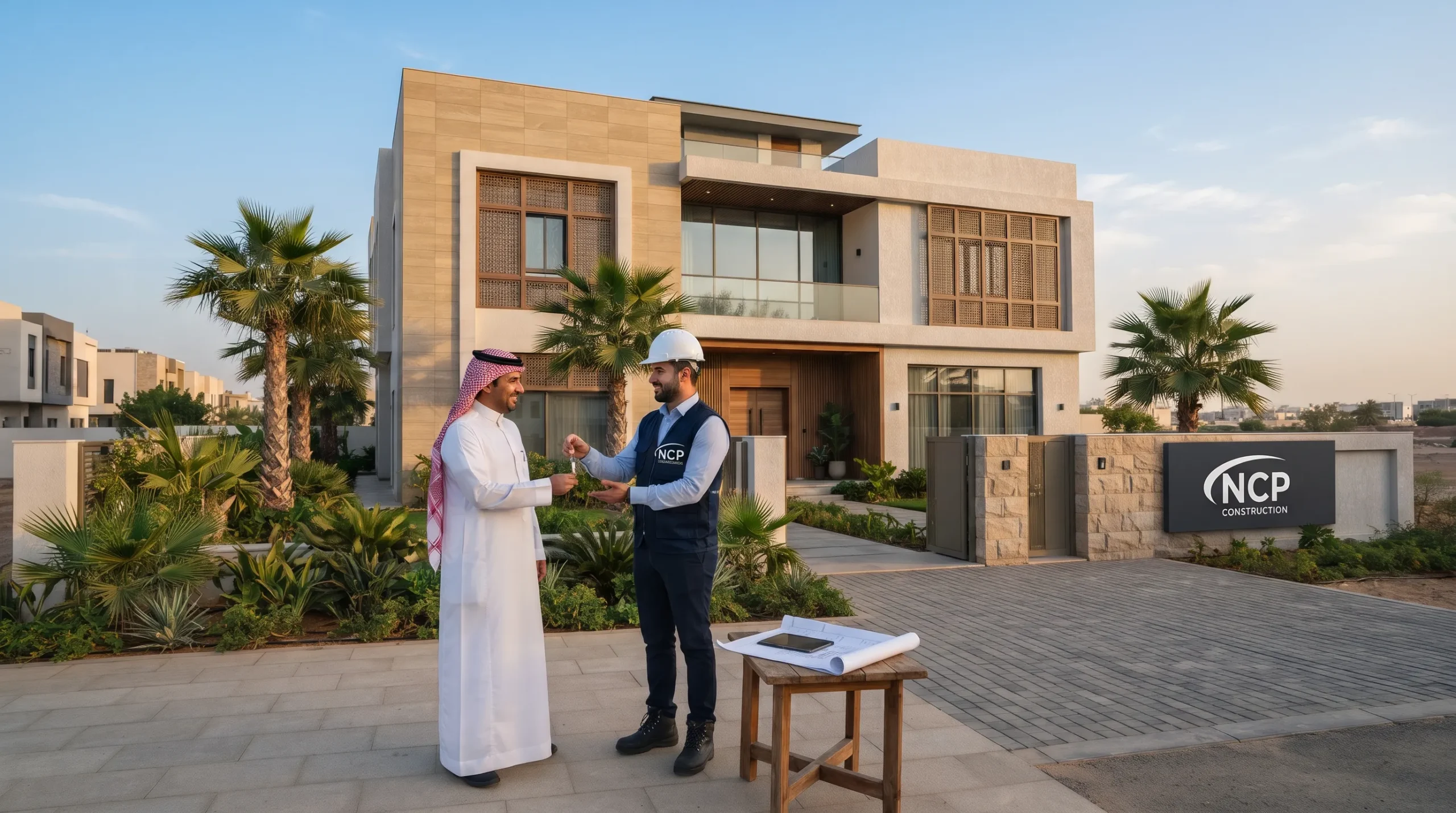
If you own a plot in Jeddah, or an empty shell you want to turn into an office, villa or restaurant, turnkey construction Jeddah comes down to one promise: a single contractor carries the project from the first drawing to the day you receive the keys. At NCP, our turnkey projects service is built around that idea, with one team responsible for civil works, finishes and coordination until handover.
This guide is for owners who want to know what actually happens along the way. We cover the permit path on Balady, the engineering plans the municipality expects, the role of the Saudi Building Code, and the contract terms that protect your budget. Where a rule comes from a government body, we point to the official source, such as the Ministry of Municipalities and Housing building permit service, so you can check the details yourself.
Communications
Phone & E-Mail
Drop A Line
Why Choose Turnkey in Jeddah?
A turnkey model puts design coordination, construction and handover under one contract, so the owner deals with one accountable party instead of five or six separate contractors. Industry references describe a turnkey contract as a single agreement covering both design and construction, often at a fixed price, where the contractor carries more of the risk (Designing Buildings).
What Does Turnkey Mean in Practice?
In daily terms, it means you stop being the project manager. Without it, an owner in Jeddah usually hires a designer, then a structural contractor, then a finishing company, then a carpenter, and spends months settling arguments about who caused a delay. With a turnkey contractor, those handoffs become our problem, not yours. The same logic sits behind the international FIDIC conditions for EPC and turnkey projects, known as the Silver Book, which place design and construction responsibility on one party.
Jeddah adds its own reasons. Coastal humidity and salt in the air affect waterproofing, steel and exterior finishes, and some districts have a high groundwater level that shapes foundation design. When one contractor owns both the structure and the finishes, these choices are made together, guided by the Saudi Building Code, instead of being argued about later.
Who Benefits Most?
Turnkey suits owners who are busy, live outside Jeddah, or are building for the first time. It also fits commercial clients who need a showroom, clinic or office open by a fixed date, and investors who want several units delivered to the same standard. In each case, turnkey construction Jeddah saves the owner from chasing separate trades across a city where summer heat, humidity and traffic already make site visits hard work. Typical projects include administrative buildings, offices, restaurants and cafés, retail showrooms and private villas, which matches the range you can see in our completed projects portfolio.
There is a trade-off worth stating plainly. You give up some day-to-day control over small choices in exchange for one clear line of responsibility. Owners who want to negotiate with every tile supplier themselves may prefer a traditional split contract. For a side-by-side look at how firms in the city work, read our earlier guide to turnkey construction companies in Jeddah.
Workflow: Design, Permits, Execution
A well-run turnkey construction Jeddah project moves through five stages: study, concept and timeline, contracting, execution, and handover. Each stage ends with something you can review, such as drawings, a schedule or a signed scope, before work moves to the next one. The stages below follow the same order we use across our construction and finishing services.
Stage 1: Study and Design
It starts with a meeting to understand the project, the budget range and the target opening date, plus a review of any drawings you already have. Design is prepared by your own consultant or by our design partners, and we check every sheet for buildability before construction, so clashes between beams, ducts and ceilings are caught on paper, not on site. We describe this early site visit and review in more detail in our article on the fit-out project process.
Stage 2: Permits on Balady
Building permits in Jeddah are applied for online through the Balady platform. Under the official procedure, the owner authorizes a licensed design engineering office, which prepares the architectural and structural designs on Balady Business, links them to the land survey report, and sends the file to a technical inspection company for review (Balady). Once the designs are approved, the request moves to the municipality.
Next comes the contracting stage, where the design office names a supervising engineering office and the building contractor. Balady requires the contractor to be classified on the platform before a permit is issued. Inherent defects insurance is also a prerequisite, and the Insurance Authority states clearly that building permits cannot be issued without the policy.
A turnkey contractor does not replace the engineering office at this point. Our job is to prepare the contractor side of the file, make sure the drawings match what will really be built, and keep the owner updated so the permit does not stall over a missing document. If you are unsure where your file stands, Balady has a building permit inquiry service that works with the permit number and the owner’s ID. Checking it yourself takes a few minutes and tells you whether the file is waiting on the designer, the inspector or the municipality.
Stage 3: Execution and Handover
Execution follows the approved drawings, starting with foundations and structure, then civil works such as block walls, partitions, floor levels and external paving. Finishes come next: floors, ceilings, paint, doors, cabinets and wall cladding. Electrical, HVAC, networks and fire systems are coordinated with specialist contractors, either appointed by the client or recommended by us, so each trade arrives on site at the right moment.
Handover is a process, not a single visit. We walk the building with the owner, record every defect on a snag list, close each item, and then deliver the space ready for use. The occupancy certificate matters here because, under Saudi law, contractors and supervising designers are jointly liable to the owner for ten years from its issuance for collapse or hidden defects that threaten safety, as explained by the law firm Clyde & Co.
Engineering Plans and Jeddah Municipality
The municipality expects a complete engineering file before it issues a permit: architectural plans with floor plans, elevations and sections, structural drawings, and supporting documents such as the ownership deed and the land survey report. Everything must be prepared by a licensed engineering office and comply with the Saudi Building Code. Requirements can change with the plot, the building use and new circulars, so the engineering office should confirm the current list before submission.
Which Saudi Building Code Parts Apply?
The Saudi Building Code is a family of mandatory codes, not a single book. For a typical turnkey building in Jeddah, the parts that matter most are the general building code (SBC 201), the concrete structures code (SBC 304), the electrical code (SBC 401), the fire code (SBC 801) and, for villas, the residential codes SBC 1101 and SBC 1102. The Saudi Building Code portal lists the codes and the bodies responsible for applying them.
Compliance is also checked during construction, not only on paper. Technical inspection visits confirm that what is built matches the approved design, and a failed inspection costs time and money. This is one reason a turnkey contractor should review the drawings with the consultant before work starts instead of improvising on site, a principle we apply on every turnkey project we manage.
Inherent Defects Insurance
Inherent defects insurance (IDI) is mandatory for contractors of residential and commercial buildings, with government buildings excluded. The cover lasts 10 years, starting from construction completion and the issuance of the occupancy certificate. The minimum cover and exclusions are set out in the standard IDI policy published by SAMA.
For owners, the practical point is simple. Because the insurance relies on technical inspection during construction, a contractor who resists inspections or cuts corners puts your permit, your occupancy certificate and your insurance at risk at the same time. Ask any contractor how they handle inspection visits before you sign, and check that they appear as a classified contractor in the Balady permit file.
Costs and Contracts
The cost of turnkey construction Jeddah work depends on three things: the area and use of the space, the finish level, and the agreed scope. We do not publish a fixed price per square meter, because two villas of the same size can differ widely once finishes and systems are chosen. Finish level alone can move the budget a lot, as you can see from the material options on our finishing works page.
What Drives the Final Price?
Beyond area and finish level, some items are often priced separately, and they are where budget surprises usually hide. Ask for each of the following to be marked as included or excluded in writing, and send us your drawings through the NCP contact page if you want a second opinion on an existing quote:
- Soil investigation and site preparation
- MEP equipment such as AC units, pumps and fire panels
- External works, boundary walls and gates
- Loose furniture and specialist joinery
- Authority, insurance and utility connection fees
Also ask how the contractor handles material price changes during the project, since steel and cement prices can move between signing and execution. A written rule for this, agreed upfront, protects both sides, as the Designing Buildings guide to turnkey contracts notes on fixed-price risk.
Contract Terms That Protect You
A good turnkey contract names one responsible party, defines the scope through drawings and specifications, links payments to completed milestones, and explains how variations are priced and approved before work on them starts. It should also state who the classified contractor is on the permit, because Balady ties the permit to that contractor (Ministry of Municipalities and Housing).
Finally, agree in writing what handover means: snag list closed, as-built drawings delivered, supplier warranties passed to you, and any post-handover support period defined. These details sound small, yet they are where most disputes between owners and contractors begin. When you compare a construction company in Jeddah against another, compare these clauses, not only the headline number, and use our turnkey projects in Jeddah page as a checklist for what a full scope should cover.
If you are ready to move from plot or shell to a working building, the next step is a short project study. Share your drawings or your site location through our contact page, and our team will review the scope with you before any price is discussed. A build and turnkey handover approach works best when the scope is clear from day one, and turnkey construction Jeddah projects are no exception.
Communications
Phone & E-Mail
Drop A Line
FAQs
Does a turnkey contractor in Jeddah issue the building permit?
Not on its own. In turnkey construction Jeddah projects, the permit is filed on Balady by a licensed design engineering office that the owner authorizes, and the classified contractor is then named during the contracting stage. The turnkey contractor prepares its part of the file and keeps the process moving, as described on the official Balady building permit page.
Can I keep my own designer under a turnkey contract?
Yes. We work with the client’s own designer or consultant, or with our design partners if you do not have one. Either way, we review the drawings for buildability before construction, as outlined on our turnkey service page.
Is turnkey only for new buildings?
No. Turnkey also covers fit-out of existing shells, such as offices, restaurants and showrooms, where the structure already exists and the work starts from civil works and finishes. Our article on the fit-out project process walks through that path from site visit to handover.